TOURISTIC SEASON 2026 LEROS
2026 Tourism Statistics in the Dodecanese: Bank of Greece Macro Analysis vs. Ground Realities in Leros and Patmos
Surging travel revenues, logistical bottlenecks at major gateway airports, and a strategic pivot toward self-sufficient island living: an in-depth briefing for homeowners, investors, and Aegean connoisseurs.
The 2026 tourist season represents a decisive turning point for the Dodecanese archipelago. The latest financial data released by the Bank of Greece (Τράπεζα της Ελλάδος), corroborated by operational airport traffic reports from Fraport Greece and the Hellenic Civil Aviation Authority (HCAA / YPA), outlines a region undergoing profound economic transformation. While top-line revenues reach historic heights, close ground-level observation—from the bustling shorelines of Rhodes and Kos to the pristine coves of Leros, Patmos, and Lipsi—demands a much more nuanced interpretation.
Behind the millions of visitors arriving on the tarmacs of Diagoras or Hippocrates lies an unprecedented trend toward island decentralization. European travelers, increasingly fatigued by mass industrial tourism and poorly managed summer heatwaves in oversized hotel complexes, are actively seeking authentic, resilient refuges. This influx toward the northern Dodecanese drives sustained real estate appreciation while underscoring critical infrastructure priorities: freshwater management, power grid stability, and the absolute necessity of hybrid solar autonomy.
1. Bank of Greece Macroeconomic Review for the Southern Aegean
According to border survey findings from the Bank of Greece, the administrative region of the Southern Aegean (Notio Aigaio) firmly secures its role as the country’s primary economic engine, generating more than 28% of total national tourism receipts in 2026. Detailed analysis of capital transfers and international card transactions highlights three key structural shifts:
3. Touristic Season 2026 Leros: The Rise of Nautical and Off-the-Beaten-Track Travel
Far from standardized mass itineraries, the island of Leros stands out in 2026 as the preserved jewel of the Dodecanese. Its singular heritage—defined by the 1930s Italian rationalist architecture of Lakki and sustained by a vibrant year-round community of 8,000 residents—safeguards it from the seasonal ghost-town effect typical of postcard-only islands.
Four primary factors drive the remarkable rise of Leros in the high-value segment:
4. Patmos: The Delicate Balance of High-End Exclusivity and Carrying Capacity
Just a few nautical miles to the northwest, Patmos zealously protects its spiritual prestige and aristocratic character. With no airport runway, sea-only access (ferries from Piraeus and express catamarans) creates a natural filter. In 2026, Patmos recorded among the highest average daily spends across Greece (€165 to €220 per visitor).
Nonetheless, tourist pressure on the Chora and the Monastery of Saint John during luxury cruise arrivals poses an evident infrastructural challenge. The local municipality has reinforced daily disembarkation quotas at Skala port to preserve the tranquility essential to its discerning villa owners and long-term second-home residents.
5. Key Data: Leros Island & 2026 Dodecanese Comparative Matrix
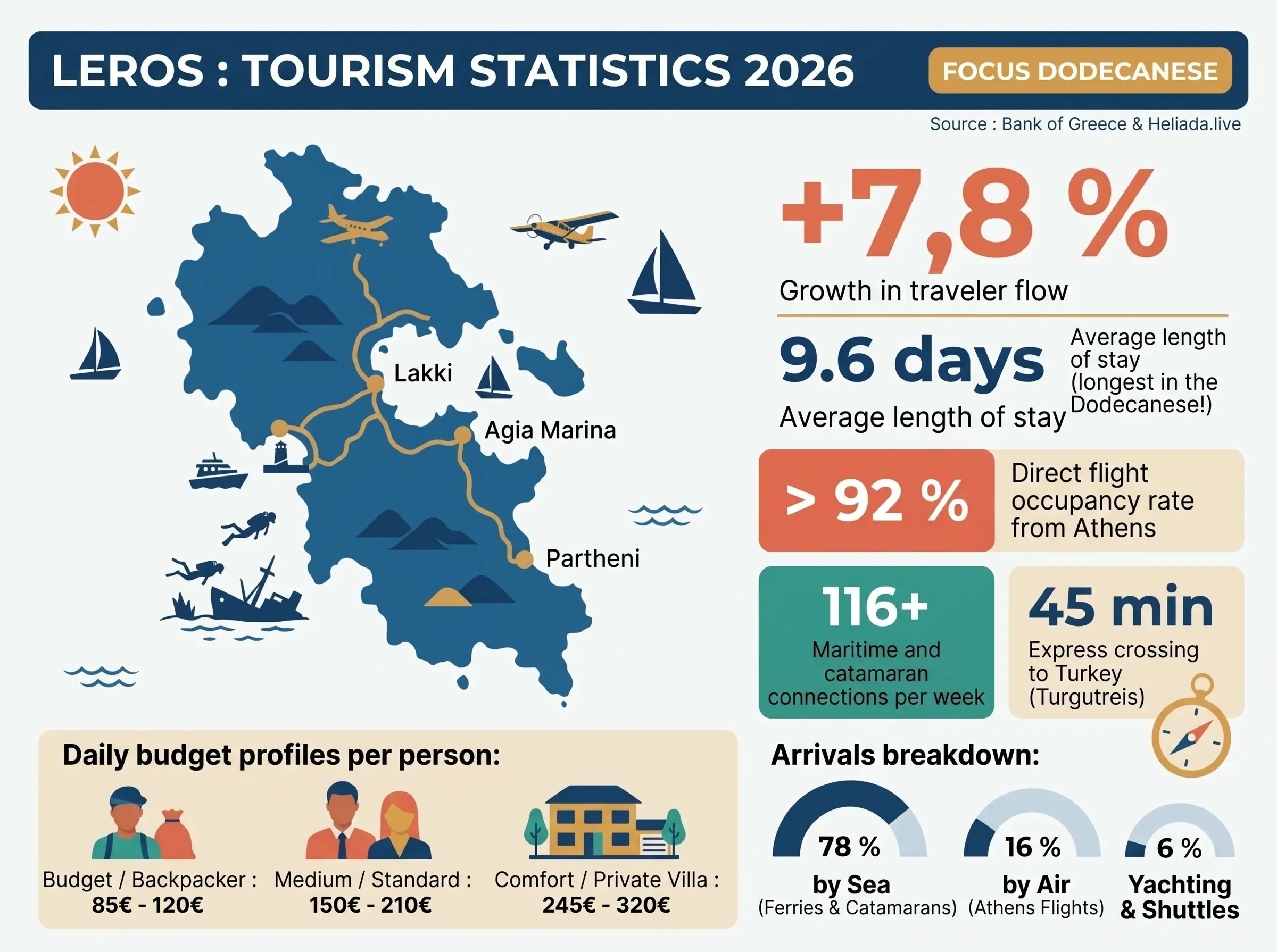
Discover below the compiled statistical review crossing Bank of Greece indicators, Civil Aviation reports, and firsthand ground data: starting with the 4 key metrics shaping the Leros ecosystem, followed by visitor daily budget breakdowns and our regional benchmark.
Estimated Daily Visitor Budget by Profile in Leros (2026)
Comparative Overview of Key Dodecanese Islands (2026)
Island / DestinationGateway Access2026 Inflow TrendAvg. Spend / NightLength of StayProfile & Strategic TrendsRhodesIntl. Airport (Diagoras) + Ferries + Mega Cruises+5.2%€88 – €957.4 daysMass tourism, large resorts, high cruise concentration.KosIntl. Airport (Hippocrates) + Bodrum Ferries+2.4%€82 – €906.8 daysAll-inclusive family resorts, cycling, active day-trip flows.Leros TOP GROWTHRegional Airport (LRS) + Dodekanisos Catamarans+7.8%€110 – €1409.6 daysYacht owners, second-home buyers, remote workers, long stays.Patmos100% Maritime (Piraeus Ferries + Fast Boats)+2.1% (Capacity Peak)€165 – €2208.2 daysExclusive high-end travelers, intellectual community, preservation.Lipsi / SymiLocal Sea Links & Feeder Lines+4.3%€95 – €1254.5 daysAuthentic island escapes, day excursions, low-impact tourism.
6. Impact on Island Real Estate: Occupancy Rates and Real Investment Yields
Financial indicators from the Bank of Greece align squarely with our active building sites and land acquisition experience in Leros: land rarity and architectural caliber are the primary drivers of long-term returns. On an island where massive hotel groups have not distorted the coastline, rental demand for bespoke, architecturally integrated residences far exceeds current supply.
7. Energy, Water, and Infrastructure: The Imperative of Resilient Autonomy
Growing visitor numbers place considerable stress on traditional island utilities. Building or investing sustainably in the Dodecanese requires decoupling from vulnerable public grids through forward-thinking engineering right from the structural phase:
Planning a Building or Renovation Project in Leros?
Benefit from independent, transparent ground-level expertise covering building permit realities (Poleodomia, e-Adeies), reliable local tradesmen, and island-grade solar engineering.