
Planning Law in Greece: Building Permit Revision vs Regularization
Legal frameworks, Law 4495/2017 procedures, notarial impacts & penalties
In Greece, planning law, buying, renovating, or constructing real estate requires a precise understanding of the legal and urban planning framework established by the Ministry of Environment and Energy (YPEN) and the Technical Chamber of Greece (TEE). Two fundamental procedures frequently arise during real estate audits and construction management: a building permit revision (Αναθεώρηση Οικοδομικής Άδειας) and the legalization or regularization of unauthorized constructions (Νομιμοποίηση / Τακτοποίηση Αυθαιρέτων).
Although both mechanisms ultimately lead to administrative compliance, their legal foundations, eligibility requirements, associated costs, and processing timelines are fundamentally distinct. Confusing the two can lead to severe financial penalties, immediate demolition orders, and insurmountable notarial blocks during real estate transactions.

1. Key Comparison: Revision vs Regularization
<table width=”100%”>
<thead>
<tr style=”background-color: #2c3e50; color: #ffffff;”>
<th align=”left” style=”padding: 14px; font-size: 16px;”>Assessment Criteria</th>
<th align=”left” style=”padding: 14px; font-size: 16px;”>Permit Revision (Αναθεώρηση)</th>
<th align=”left” style=”padding: 14px; font-size: 16px;”>Regularization / Legalization (Νομιμοποίηση)</th>
</tr>
</thead>
<tbody>
<tr style=”background-color: #ffffff;”>
<td style=”padding: 12px; font-weight: bold; border-bottom: 1px solid #e0e0e0;”>Initial Legal Status</td>
<td style=”padding: 12px; border-bottom: 1px solid #e0e0e0; color: #27ae60;”>Lawful (active and valid building permit in place)</td>
<td style=”padding: 12px; border-bottom: 1px solid #e0e0e0; color: #c0392b;”>Unlawful / Arbitrary (Aythaireto)</td>
</tr>
<tr style=”background-color: #f9f9f9;”>
<td style=”padding: 12px; font-weight: bold; border-bottom: 1px solid #e0e0e0;”>Timing & Context</td>
<td style=”padding: 12px; border-bottom: 1px solid #e0e0e0;”>During construction or before permit expiration</td>
<td style=”padding: 12px; border-bottom: 1px solid #e0e0e0;”>After completion of unauthorized building works</td>
</tr>
<tr style=”background-color: #ffffff;”>
<td style=”padding: 12px; font-weight: bold; border-bottom: 1px solid #e0e0e0;”>Governing Legislation</td>
<td style=”padding: 12px; border-bottom: 1px solid #e0e0e0;”>Law 4495/2017 (Permits) & General Building Code (NOK)</td>
<td style=”padding: 12px; border-bottom: 1px solid #e0e0e0;”>Law 4495/2017 (Articles 81 to 125 for Arbitrary Bldgs)</td>
</tr>
<tr style=”background-color: #f9f9f9;”>
<td style=”padding: 12px; font-weight: bold; border-bottom: 1px solid #e0e0e0;”>Eligibility Cut-off Date</td>
<td style=”padding: 12px; border-bottom: 1px solid #e0e0e0;”>No historical cut-off date</td>
<td style=”padding: 12px; border-bottom: 1px solid #e0e0e0; font-weight: bold; color: #d35400;”>Strict Cut-off Date: July 28, 2011</td>
</tr>
<tr style=”background-color: #ffffff;”>
<td style=”padding: 12px; font-weight: bold; border-bottom: 1px solid #e0e0e0;”>Submission Platform</td>
<td style=”padding: 12px; border-bottom: 1px solid #e0e0e0;”>National electronic system “e-Adeies” (TEE)</td>
<td style=”padding: 12px; border-bottom: 1px solid #e0e0e0;”>TEE Arbitrary Declaration Registry</td>
</tr>
<tr style=”background-color: #f9f9f9;”>
<td style=”padding: 12px; font-weight: bold; border-bottom: 1px solid #e0e0e0;”>Administrative Fees</td>
<td style=”padding: 12px; border-bottom: 1px solid #e0e0e0;”>Standard municipal fees and engineer design fees</td>
<td style=”padding: 12px; border-bottom: 1px solid #e0e0e0;”>Filing fee (Paravolo) + Substantial unified fine</td>
</tr>
<tr style=”background-color: #ffffff;”>
<td style=”padding: 12px; font-weight: bold; border-bottom: 1px solid #e0e0e0;”>Impact on Real Estate Sale</td>
<td style=”padding: 12px; border-bottom: 1px solid #e0e0e0;”>Maintains full transferability and legal title</td>
<td style=”padding: 12px; border-bottom: 1px solid #e0e0e0;”>Requires TEE Engineer Certificate to execute deed</td>
</tr>
<tr style=”background-color: #f9f9f9;”>
<td style=”padding: 12px; font-weight: bold;”>Technical Oversight</td>
<td style=”padding: 12px;”>Building Inspector inspection (Elektis Domisis)</td>
<td style=”padding: 12px;”>Structural vulnerability audit (DEDOTA) & survey</td>
</tr>
</tbody>
</table>
</div>
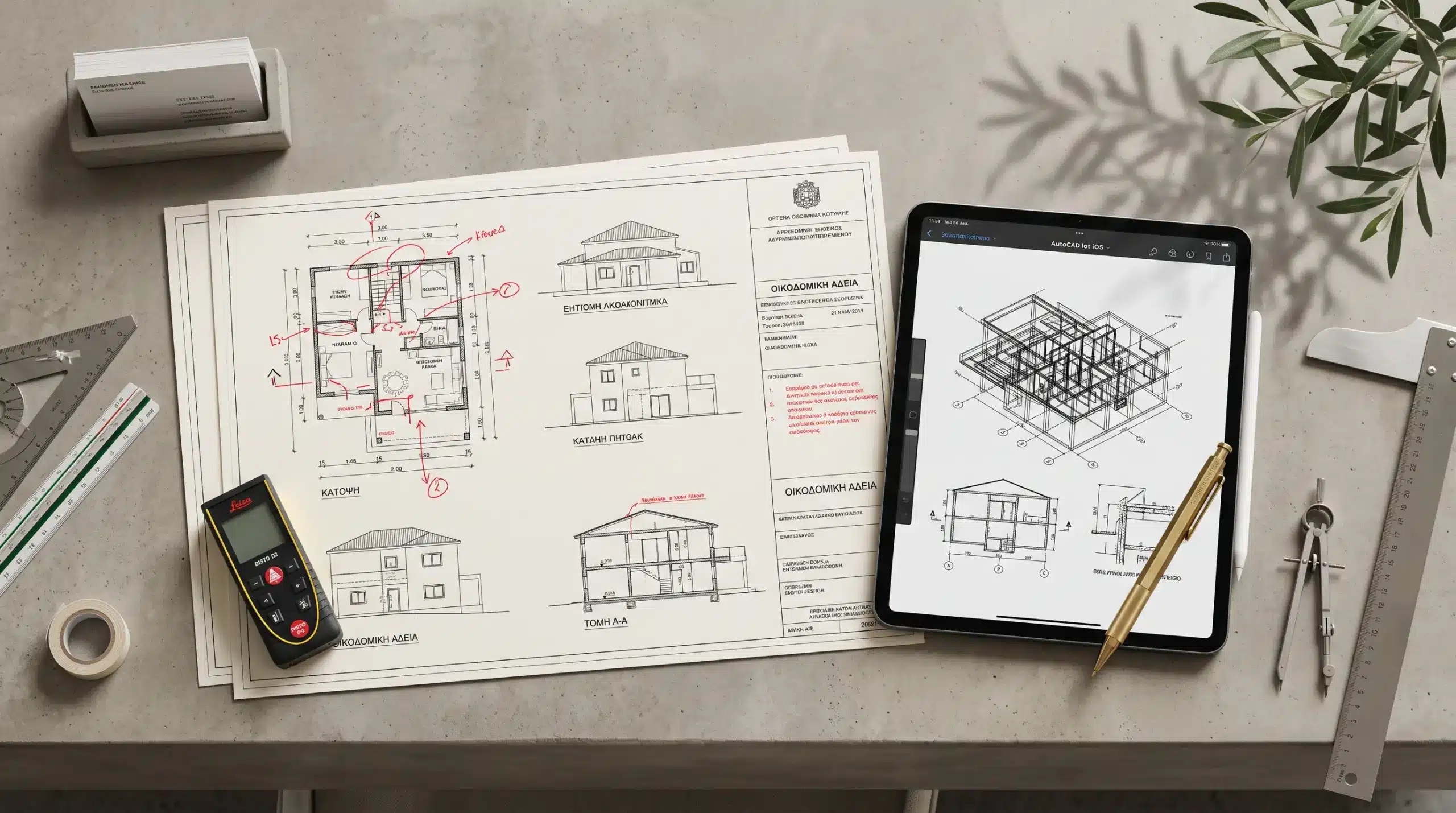
Procedure: Permit Revision
Applied during active construction to adapt an existing permit before works reach full completion.
Procedure: Regularization (Law 4495)
Applied to built structures executed either without a prior permit or beyond the approved plans.

2. Legal, Notarial & Financial Implications
1. Notarial Conveyance & Electronic Building Identity (ITK): Under Greek real estate law, no transfer deed (purchase, sale, donation, parental grant) or mortgage can be validly executed without a licensed Civil Engineer’s Certificate (Βεβαίωση Μηχανικού) registered in the national Electronic Building Identity system (Ηλεκτρονική Ταυτότητα Κτιρίου – ITK). Any unregularized architectural deviation renders the deed null and void by operation of law.
2. Public Utility Connections (DEDDIE, EYDAP): Establishing permanent connections to the electrical power grid or water supply network requires formal certification issued by the municipal planning office (YDOM) or an official certificate confirming that at least 30% of the statutory fine under Law 4495 has been paid.
3. Site Inspections & Criminal Liability: Commencing unauthorized modifications on an active construction site without prior permit revision triggers an immediate work-stop order (Διακοπή Εργασιών), heavy building and annual maintenance fines, and potential criminal misdemeanor charges against both the property owner and the supervising engineer.